
Loose Skin After Weight Loss: Causes, Treatment Options, and When Surgery May Be Considered
Dr Varun Harish, FRACS Plastic Surgeon
First published:
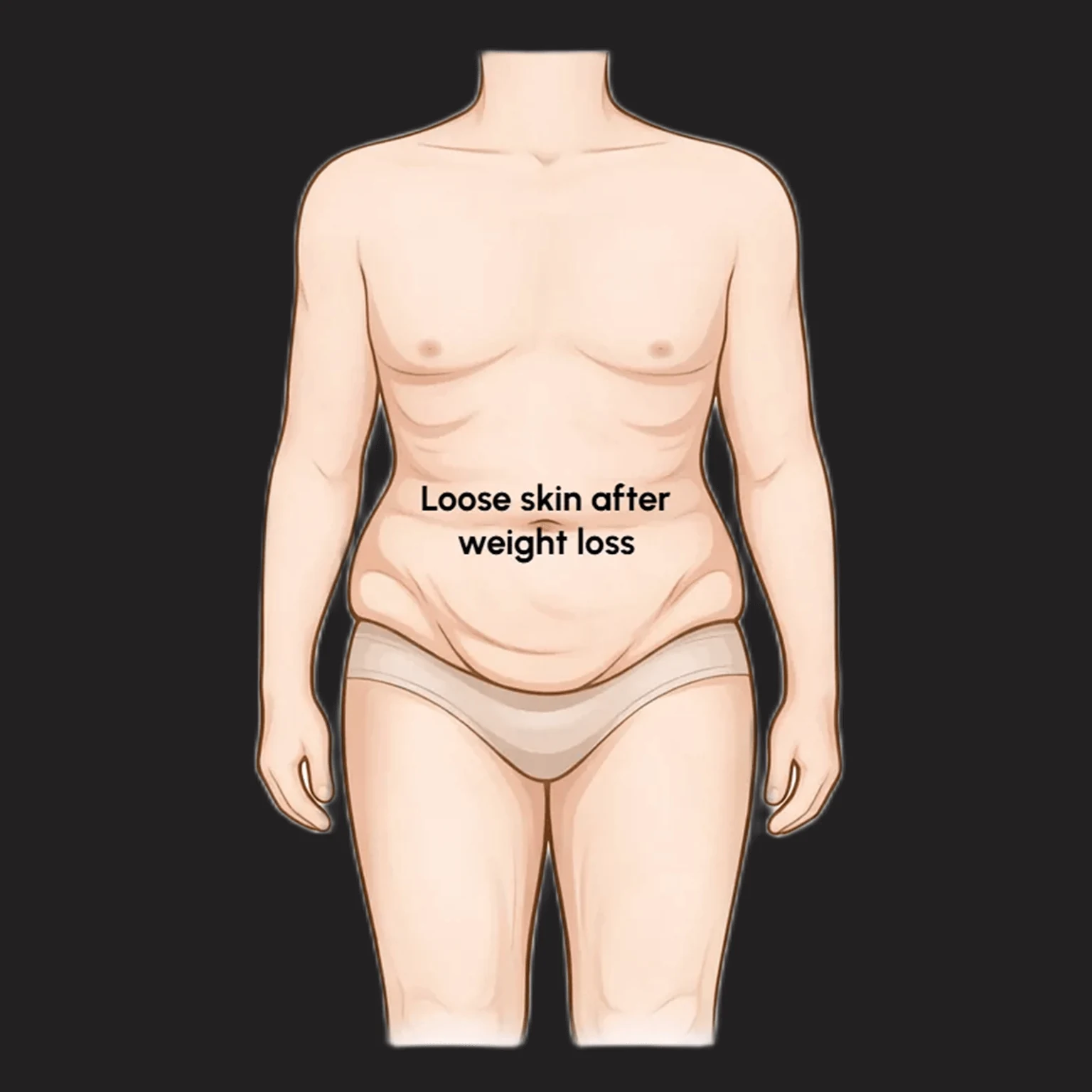
Loose skin after weight loss refers to excess skin that remains after fat is lost, when the skin does not fully shrink back to match the body’s new shape.
After significant weight loss, many people are surprised to find that loose skin remains. This often raises questions about whether surgery is necessary, what type of surgery may be appropriate, or whether no surgery is needed at all. Patients often ask which surgery is best after weight loss, or whether they need a tummy tuck (abdominoplasty) or a body lift (360° body lift / belt lipectomy).
In practice, surgeons usually consider three broad pathways: no surgery, limited skin removal for one area, or more extensive body contouring when loose skin affects multiple areas and daily comfort. When loose skin extends beyond the front of the abdomen into a circumferential (360°) lower torso pattern involving the flanks and lower back, this broader approach is often described as a body lift (also called a 360° body lift or belt lipectomy). This article explains how those decisions are made and when body lift surgery might be considered, focusing on anatomy of excess skin, timing of surgery, and impacts on function.
Loose or excess skin can may also develop after pregnancy or a Caesarean section, where changes in the lower abdomen can resemble loose skin or skin overhang.
How Decisions About Excess Skin Are Made
Loose or excess skin after weight loss is common and does not always require surgery. Decisions about excess skin removal after weight loss depend on where loose skin is located, whether weight has stabilised, and whether skin folds cause functional problems such as rashes, hygiene difficulties, or discomfort with movement or exercise. In some cases, no surgery is needed; in others, targeted procedures such as a tummy tuck (abdominoplasty) or more extensive surgery such as a body lift for circumferential excess skin may be considered.
Excess skin removal is not weight-loss surgery. It refers to surgery performed after weight reduction to remove persistent loose skin, improve function, and in some cases improve body contour and clothing fit.
Another term for excess skin removal is skin removal surgery after weight loss or post-weight-loss body contouring.
Some patients also explore whether Medicare rebates may apply depending on their symptoms.
Do I Need a Tummy Tuck or a Body Lift After Weight Loss?
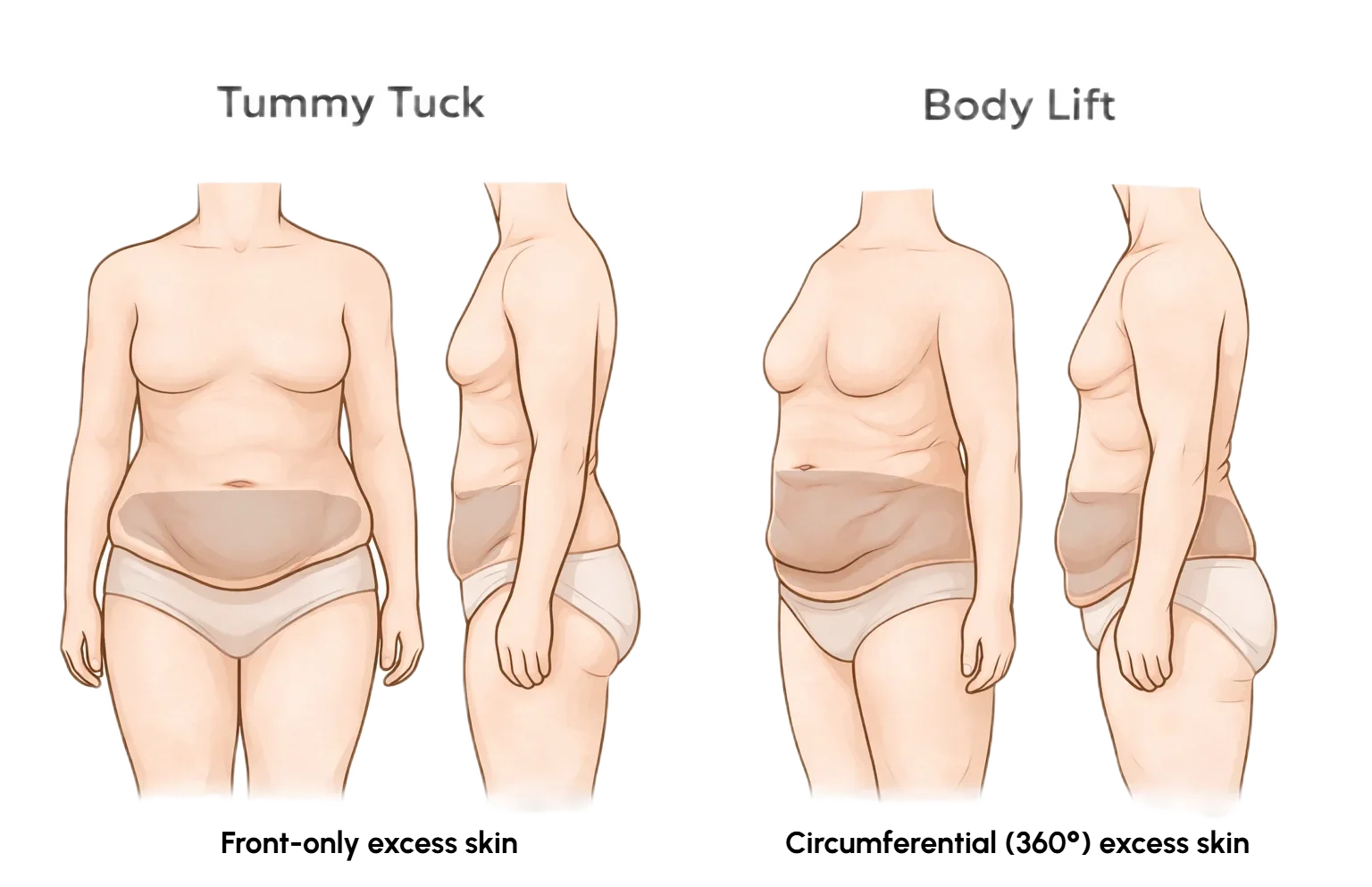
The main difference between a tummy tuck and a body lift after weight loss is how far excess or loose skin extends around the torso. A tummy tuck treats loose skin at the front of the abdomen. A body lift treats loose skin around the lower torso, including the sides and lower back.
- Front of the abdomen only → a tummy tuck (abdominoplasty) may be considered.
- Front, sides, and lower back → a body lift (lower body lift / 360° body lift / belt lipectomy) may be discussed.
Surgeons also consider residual fat, abdominal wall laxity, functional symptoms such as rashes or hygiene problems, and weight stability before recommending the most appropriate procedure.

Loose Skin After Weight Loss
Weight loss reduces body fat, but skin does not always shrink back to match the new body shape. When skin has been stretched for a long time, it may not fully tighten even after weight is lost.
Skin behaves differently from fat. Fat volume can decrease relatively quickly, while skin has more limited ability to recoil or deflate once it has been stretched beyond a certain point. As a result, some degree of loose or excess skin is common after weight loss, including loose skin after bariatric surgery and after Ozempic or Wegovy weight loss.
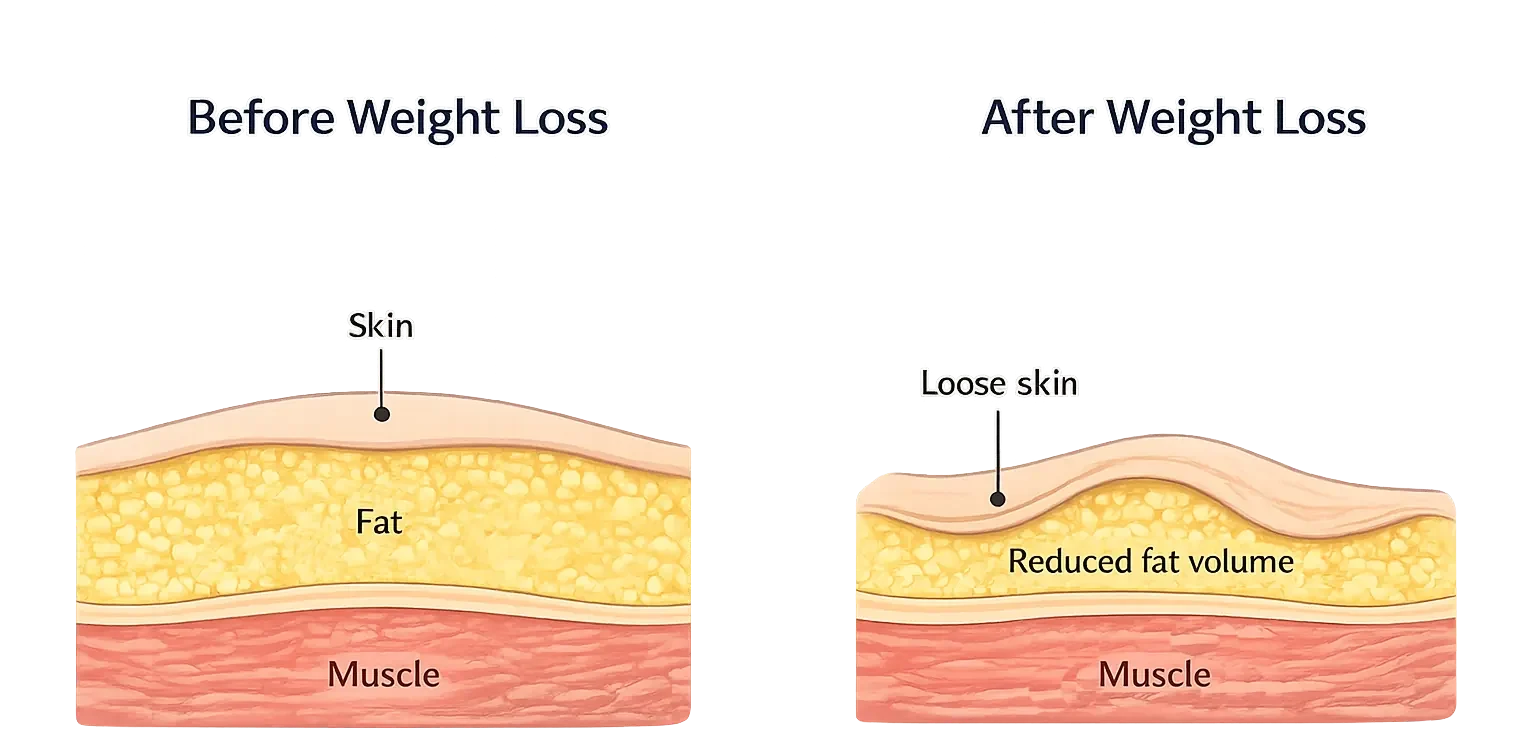
Factors that influence how much loose skin remains include:
- the total amount of weight lost
- how long the body carried excess weight
- age and overall skin quality
- genetic factors and cumulative sun exposure
- smoking history
Loose skin is often more noticeable after rapid or significant weight loss, but it can also occur after gradual weight loss, especially when excess weight was present for many years.
Common Patterns of Loose Skin After Weight Loss
These changes are often described as post-weight-loss body contour changes, and in people who have lost large amounts of weight they may be part of post-bariatric body contouring discussions.
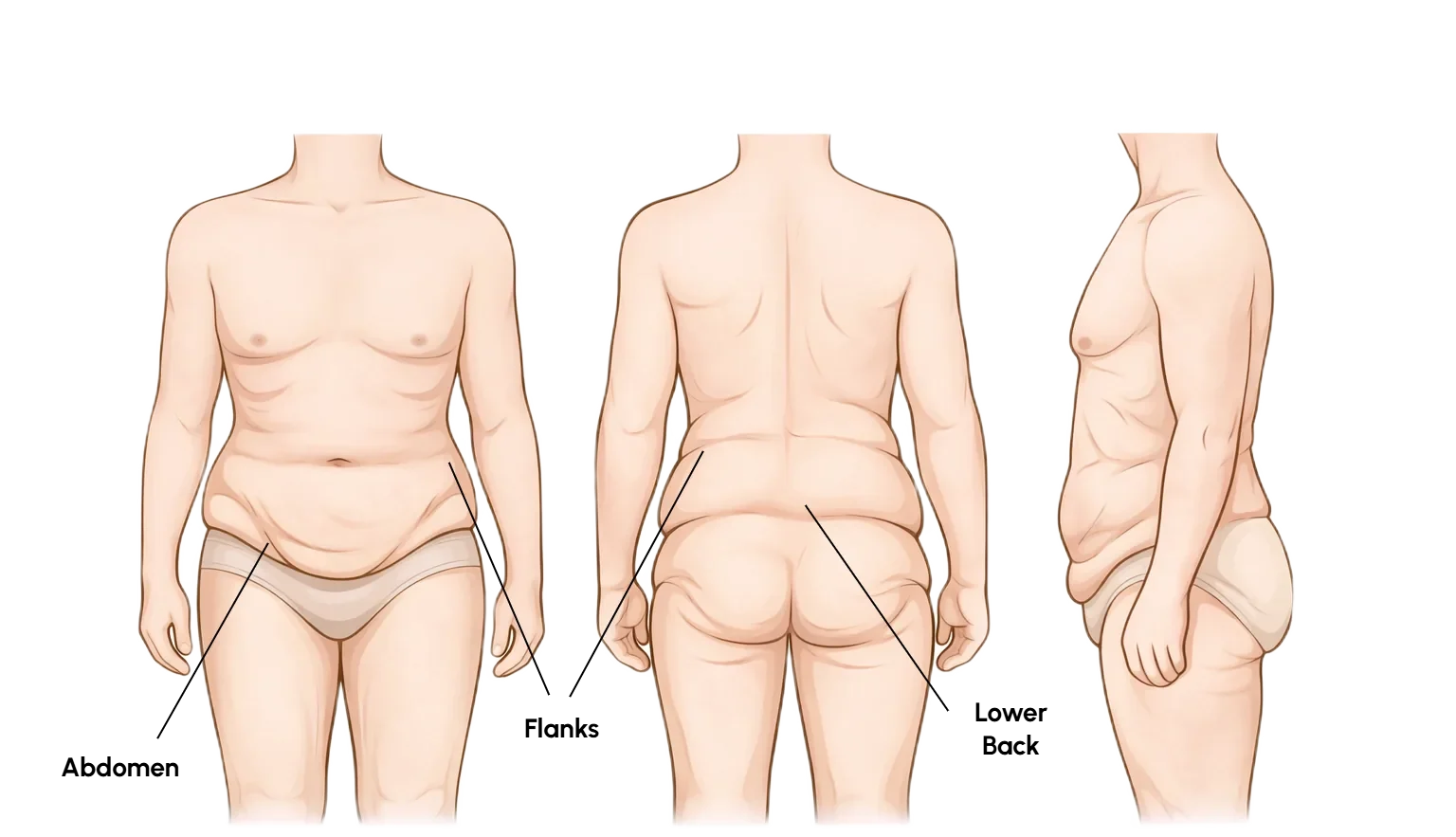
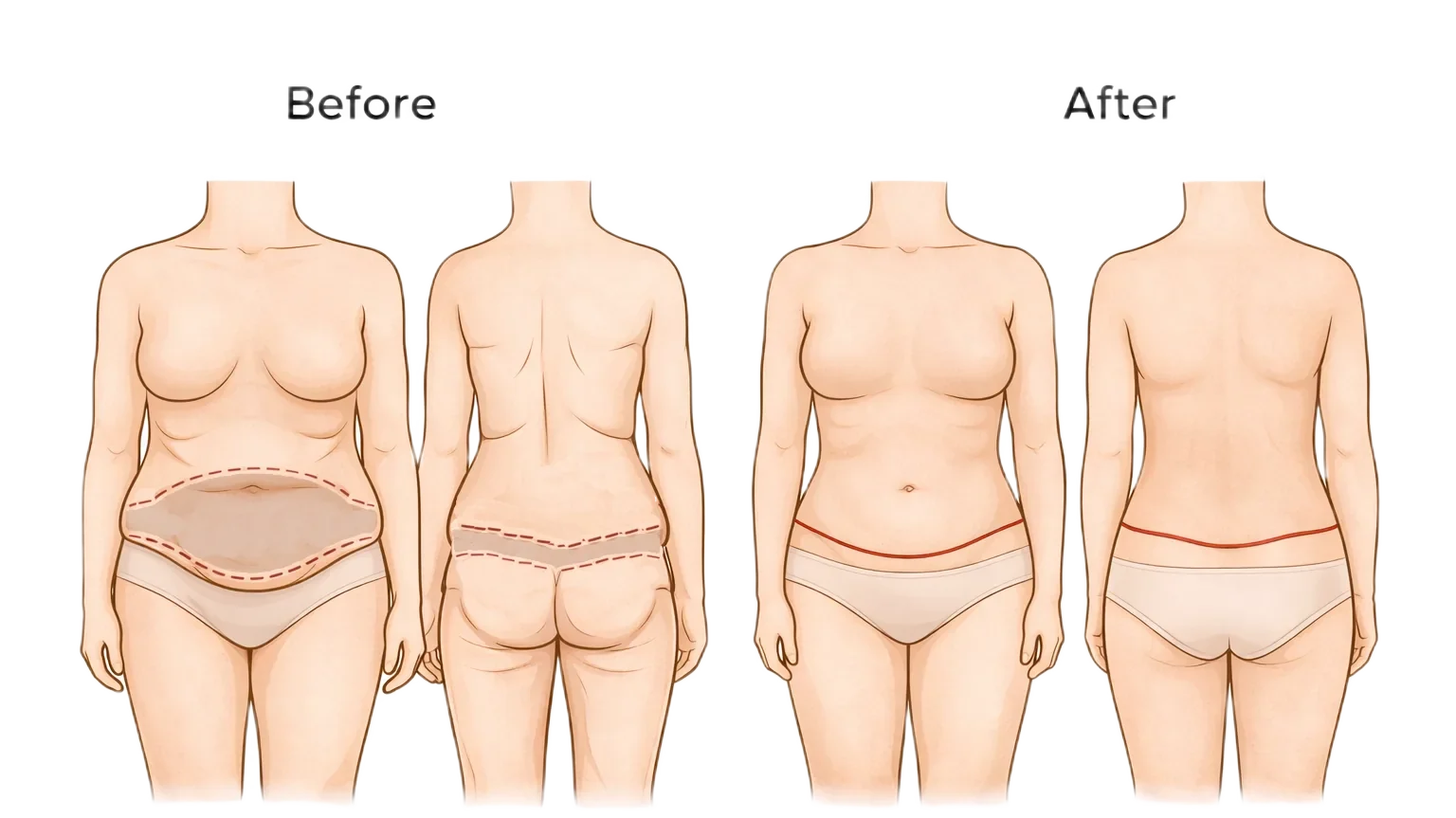
Loose skin after weight loss rarely affects only one body area. It often follows a belt-like distribution of excess skin across the lower abdomen, flanks, and lower back. After major weight loss, the supporting structures of the lower torso also stretch, allowing tissues around the waistline to descend or drop. This is why excess skin after weight loss often appears in a circumferential or 360° pattern rather than affecting only the front of the abdomen.
In some people, the lower abdomen forms an overhang known as a pannus or skin “apron.” Patients often describe this as hanging skin, skin overhang, or an apron stomach after weight loss. These patterns of excess skin reflect loss of internal support combined with gravity.
In some people, the outer thighs or buttock tissues may also descend after major weight loss. The distribution of excess skin is one of the most important factors in determining whether excess skin removal or broader body contouring after weight loss is discussed.
Why the Abdomen May Still Look Bulky After Weight Loss
After significant weight loss, the remaining contour of the abdomen is not always caused by loose skin alone. Several factors can contribute to the shape of the abdomen after weight reduction:
- loose skin, which may hang or fold
- residual fat, which may remain in deeper layers
- abdominal wall laxity or weakness, where the underlying muscles have stretched
- distribution of tissue around the flanks or lower back
Because these factors can occur together, the appearance after weight loss may not always improve with further weight reduction alone. During consultation, surgeons therefore assess whether the remaining contour is primarily caused by excess or loose skin, residual fat, abdominal wall laxity, muscle separation, or a combination of these factors.
Does the Method of Weight Loss Change Surgical Planning?
People lose weight in different ways, including lifestyle change, bariatric surgery, or weight-loss medications such as Ozempic, Wegovy, or Mounjaro. From a surgical perspective, the amount of weight lost and how quickly it occurs usually matter more than the method itself. Rapid or substantial reductions in body fat can leave the skin with less underlying support, making existing skin laxity more visible. In practice, surgeons focus less on how the weight loss occurred and more on the pattern of excess skin and how it affects the lower torso and waistline.
Weight-loss medications do not directly cause loose skin. Instead, loose skin develops when fat volume decreases faster than the skin can retract. The same principles apply whether weight loss occurs through medication, bariatric surgery, or lifestyle changes.
Many patients now ask about loose skin after Ozempic, Wegovy or Mounjaro weight loss. The same principles apply: rapid loss of fat volume can make existing skin laxity more visible.
Loose Skin After Bariatric Surgery and Post-Bariatric Body Contouring
Patients who lose a large amount of weight (massive weight loss) following bariatric surgery (such as gastric sleeve or gastric bypass) often develop more significant skin laxity. This occurs because:
- the skin has been stretched for a prolonged period
- the amount of weight loss may be substantial
- skin elasticity may be reduced after large weight fluctuations
For these reasons, some patients eventually consider body contouring procedures once their weight has stabilised.
The most appropriate procedure depends on the distribution of excess skin and the presence of symptoms, rather than the weight-loss method alone.
Skin Folds, Rashes, and Comfort Issues After Weight Loss
For many people, excess skin causes physical discomfort.
Common functional problems include:
- moisture and sweating trapped within skin folds
- chafing and irritation
- recurrent rashes (sometimes called intertrigo)
- difficulty maintaining hygiene
- discomfort during exercise or everyday movement
These symptoms are medically relevant and should be assessed.
What a Plastic Surgeon Looks For During the Consultation and Examination
During consultation for loose skin after weight loss, the assessment focuses on identifying the pattern of excess tissue rather than simply measuring weight loss.
The surgeon typically evaluates:
- where the loose skin is located
- whether there is circumferential or 360° waistline laxity involving the abdomen, flanks and lower back
- the presence of residual fat deposits
- abdominal wall shape
- symptoms caused by skin folds
Excess skin is assessed by observing how it behaves when standing and moving, not only when lying flat. Assessment also considers skin quality, mobility, and distribution, alongside functional impact and personal priorities.
This examination helps determine whether the most appropriate discussion involves no surgery, a tummy tuck, panniculectomy, or a body lift.
Helpful preparation may include:
- weight history and duration of stability
- current medications (including weight-loss medications)
- symptoms such as rashes, irritation, sweating, or hygiene difficulties
How Surgeons Decide Which Procedure May Be Appropriate
When assessing loose skin after weight loss, surgeons usually consider several possible pathways rather than assuming surgery is automatically required.
The most appropriate approach depends primarily on:
- the distribution of excess skin
- whether residual fat is present
- the degree of abdominal wall laxity
- the presence of functional symptoms such as rashes or hygiene problems
- the patient’s overall health and weight stability
Different patterns of excess tissue tend to lead to different discussions.
| Situation | Possible Approach | Why |
|---|---|---|
| Mild skin excess without symptoms | No surgery | Skin may improve gradually and surgery may not be necessary |
| Excess skin limited to the lower abdomen | Tummy tuck (abdominoplasty) may be considered | Removes excess skin from the front of the abdomen |
| Large apron of hanging skin causing irritation | Panniculectomy may be considered | Removes the hanging skin fold that causes symptoms |
| Circumferential (360°) loose skin in a belt-like pattern around the waistline (abdomen, flanks, and lower back) | Body lift (360° belt lipectomy) may be discussed | Addresses skin excess around the entire lower torso |
The goal of this assessment is not simply to remove as much skin as possible, but to choose the procedure that best improves contour, function, and long-term results while balancing scar placement and recovery.
Signs That More Extensive Skin Removal May Be Appropriate
In some people, loose skin remains widespread and continues to cause problems even after weight has stabilised.
Common features that point toward more extensive excess skin removal include:
- loose skin affecting multiple areas of the lower torso
- persistence despite stable weight
- interference with clothing or movement
- recurrent skin-fold irritation despite routine care
- difficulty maintaining hygiene in skin folds
A rounded or full appearance after weight loss usually reflects loose skin, remaining fat, muscle shape, or a combination of these factors.
General guide (not diagnostic):
- Loose skin: folds or creases; thinner, “empty” feel
- Remaining fat: thicker, fuller feel; similar in different positions
- Muscle shape: firmer; changes with posture
If fullness is mainly fat rather than skin, management options differ and are assessed separately.
Timing and Weight Stability Before Surgery
Timing matters when considering excess skin removal or skin removal surgery after weight loss. Most surgeons recommend waiting until weight has been stable for several months. Further weight loss can increase the amount of loose skin, while weight regain reduces predictability.
Stable weight usually means no ongoing upward or downward trend, with only minor day-to-day fluctuations, over several months.
Weight stability allows more accurate assessment of how much excess skin is present and how it behaves. Medical readiness is separate: overall health, nutritional status, and smoking status affect safety and healing regardless of how weight loss occurred.
Who May Be a Candidate for Skin Removal Surgery After Weight Loss?
Not everyone who loses weight will need surgery for loose skin. Many people notice some degree of skin laxity after weight loss, but in some cases the excess skin becomes significant enough to cause functional problems or persistent contour concerns.
Skin removal surgery after weight loss may be considered when several factors are present.
Stable Weight
Surgery is usually considered once weight has stabilised for a period of time. Continued weight loss after surgery can affect the final result, and weight regain can stretch the tissues again. For this reason, surgeons typically look for a period of relatively stable weight (usually about 3-6 months) before planning post-weight-loss body contouring.
Persistent Excess or Overhanging Skin
Candidates often have loose skin that forms folds, drapes, or hangs despite reaching their target weight. Patients commonly describe this as loose belly skin after weight loss, a hanging stomach, or an apron of skin in the lower abdomen. When skin redundancy is significant, it does not tighten on its own.
Symptoms Caused by Skin Folds
Excess skin can cause functional symptoms rather than purely cosmetic concerns. These may include:
- recurrent rashes or skin irritation in folds
- moisture or hygiene difficulties
- discomfort during physical activity
- difficulty with clothing fit
- skin infections in deeper folds
When these issues occur repeatedly, procedures such as panniculectomy may be considered to remove the problematic skin fold.
Distribution of the Excess Skin
The pattern of loose skin is one of the most important factors in deciding whether surgery may help.
Some people have excess skin mainly limited to the front of the abdomen, while others develop circumferential laxity involving the abdomen, flanks, lower back, buttocks, or thighs. The distribution of excess tissue helps determine whether a limited procedure such as a tummy tuck may be appropriate or whether a broader body contouring procedure, such as a lower body lift, may be discussed.
Overall Health and Surgical Suitability
As with any surgery, general health is important. Surgeons assess factors such as nutrition, smoking status, medical conditions, and the ability to safely undergo an operation and recovery period.
Realistic Expectations
Skin removal surgery improves excess skin and body contour, but it involves scars and recovery time. Candidates are usually people who understand the trade-off between improved contour and the presence of surgical scars.
Who is a Candidate for Skin Removal Surgery After Weight Loss?
Skin removal surgery after weight loss is typically considered when weight has stabilised for at least 3-6 months, loose skin remains significant, and symptoms or contour concerns persist despite reaching a healthy weight. The pattern of excess skin and overall health help determine whether procedures such as panniculectomy, tummy tuck, or body lift may be appropriate.
Situations Where Loose Skin Can Be Managed Without Surgery
Not everyone with loose skin after weight loss needs surgery. Mild skin looseness, early weight change, or ongoing weight loss can be managed without surgery.
Skin appearance may improve gradually as weight stabilises. When loose skin does not interfere with comfort, hygiene, clothing, or daily activity, observation can be appropriate.
Exercise can improve muscle tone but it does not remove excess skin. For significant skin excess, topical products or devices cannot remove extra skin; at best, they may improve skin texture. Reassessment over time is often appropriate.
Once there is true skin excess with folds or overhang, exercise and skin-tightening products cannot remove the extra skin itself.
What a Body Lift Is
A body lift (or 360° body lift, lower body lift or belt lipectomy) is a form of excess skin removal for people with circumferential (360° - all the way around) lower torso skin laxity, typically involving the abdomen, flanks, and lower back (usually after significant weight loss). Unlike a tummy tuck, which focuses on the front of the abdomen, a body lift removes excess skin circumferentially (360°) around the lower torso, aiming to improve excess skin folds, comfort, and clothing fit across the waistline. Because a body lift treats the lower torso circumferentially, it may also improve laxity affecting the outer thighs and descent of the buttock tissues in some patients after major weight loss.
| Procedure | Main Purpose | Typical Situation |
|---|---|---|
| Panniculectomy | Remove overhang ‘apron’ of skin from abdomen | Large overhang causing rashes or hygiene issues |
| Tummy tuck | Remove lower abdominal skin and improve contour | Loose skin mainly at front of abdomen |
| Body lift | Remove circumferential (360°) lower torso skin | Loose skin affecting abdomen, flanks, and lower back |
What Is a Panniculectomy?
Some patients develop a large fold of hanging skin on the lower abdomen after significant weight loss. This overhanging fold is sometimes called a pannus or skin apron.
A panniculectomy is an operation that removes this hanging fold of excess skin and soft tissue from the lower abdomen. Unlike a tummy tuck, a panniculectomy typically focuses on removing the overhanging skin fold itself, rather than reshaping the abdominal wall or tightening muscles.
This operation may be discussed when:
- a large skin apron causes irritation or hygiene problems
- the skin fold causes recurrent rashes or infections
- the excess skin interferes with mobility or clothing
A panniculectomy is not the same as a formal body-contouring procedure. Its main purpose is removal of the symptomatic hanging apron. If the main concern is excess skin in a belt-like distribution, or flank skin excess, or overall waistline contour after major weight loss, a panniculectomy alone is unlikely to address those issues. In these patients, where the excess skin involves a broader area of the torso, a body lift may be more appropriate.
When a Tummy Tuck Is Enough — and When a Body Lift Is Considered
The main difference between a tummy tuck and a body lift after weight loss is how far loose skin extends around the torso. A tummy tuck (abdominoplasty) mainly treats loose skin on the front of the abdomen. A body lift (also called a lower body lift, 360° body lift, or belt lipectomy) treats excess skin that extends around the lower torso, including the abdomen, flanks, and lower back.
For this reason, the most important factor in deciding between these procedures is how far the loose skin extends around the body. If the excess skin is limited mainly to the front of the abdomen, a tummy tuck may be sufficient. If the loose skin follows a circumferential lower torso pattern involving the flanks and lower back, a body lift may sometimes be discussed because it allows more complete waistline skin tightening.
In patients whose excess tissue continues around the waistline, limiting surgery to the front may leave persistent side or back loose skin. This is one reason post-weight-loss body contouring is planned according to the pattern of excess tissue rather than the name of the operation alone.
A simple way surgeons often describe the difference between a tummy tuck and body lift is:
- Front-only loose skin: often aligns with tummy-tuck-type options.
- Front and sides: usually requires a broader approach.
- Front, sides, and back (belt-like pattern around the waistline): typically leads to discussion of a lower body lift.
For this reason, the discussion is sometimes framed as tummy tuck vs body lift after weight loss, depending on how far excess skin extends around the torso.
Eligibility for Medicare for tummy tuck and body lift depends on the presence of functional problems.
Balancing Skin Removal and Scar Placement
Operations that remove excess skin after weight loss often involve longer scars than many patients initially expect. This is because the amount of skin that must be removed is usually proportional to the amount of laxity present. Although the scars of a body lift are longer, they are usually placed in areas that can be hidden by underwear or swimwear. Importantly, the goal is not simply to produce the shortest scar, but to achieve the best overall contour and functional improvement.
Key Factors to Consider Before Seeking Specialist Advice
Before seeking specialist advice, consider weight stability, overall health, and nutrition. All forms of excess skin removal involve scars; decisions balance improved comfort, mobility, and clothing fit against scar burden. Recovery varies depending on the extent of surgery, with more extensive procedures such as a body lift involving a longer recovery period than operations limited to the lower abdomen. More detailed information about recovery after a body lift is available on the body lift surgery page.
In the Australian healthcare system, Medicare rebates may apply in circumstances where excess skin causes documented medical problems such as recurrent rashes, infections, or hygiene difficulties rather than appearance concerns alone. Eligibility depends on individual assessment and criteria.
Learn how Medicare item 30179 applies and whether you may qualify.

If you are unsure whether your concerns are mainly loose skin, residual fat, or circumferential laxity, this is usually clarified during consultation and examination.
Frequently Asked Questions
Why do I still have loose skin after losing weight?
Loose skin remains because skin cannot tighten effectively following weight loss. When skin has been stretched for a long time, it loses its ability to fully shrink back.
Will loose skin tighten on its own over time?
Mild looseness may improve once weight stabilises, but significant excess skin usually does not tighten fully on its own after major weight loss. The greater the weight loss, the more loose skin that is likely to remain.
Does Ozempic, Wegovy, or Mounjaro cause loose skin?
Weight-loss medications do not cause loose skin. Loose skin results from loss of fat volume after weight loss, regardless of whether weight loss occurs through medication, surgery, or lifestyle change.
Can exercise tighten loose skin?
Exercise can improve muscle tone and overall shape, but it does not remove excess skin once skin has lost its ability to recoil or tighten.
How do I know if it’s loose skin or fat?
Loose skin tends to form folds and feel thin or “empty,” while remaining fat feels thicker and fuller. Distinguishing between the two usually requires assessment while standing and moving.
How long should my weight be stable before considering skin removal surgery after weight loss?
Most surgeons look for a period of stable weight, meaning no ongoing upward or downward trend, with only minor day-to-day fluctuations, over several months. The timeframe commonly used is 3 to 6 months of stable weight.
How much weight do I need to lose before considering excess skin removal?
There is no specific weight threshold. Decisions are based on weight stability, distribution of loose skin, and whether symptoms such as rashes or discomfort are present.
What is the difference between a tummy tuck and a body lift?
A tummy tuck addresses loose skin at the front of the abdomen and may tighten separated six-pack muscles (e.g., after pregnancy and/or C-section). A body lift addresses loose skin that extends around the sides and lower back as well as the front, often after significant weight loss.
Is a body lift the same as a 360 or lower body lift?
These terms are often used interchangeably. They generally refer to surgery that removes excess skin in a circumferential pattern around the lower torso, including the abdomen, flanks, and lower back.
Who may be a candidate for a body lift after weight loss?
A body lift may be considered when excess skin extends beyond the front of the abdomen to involve the flanks and lower back, especially after major weight loss. Surgeons also consider weight stability, overall health, nutritional status, smoking, and whether skin folds are causing discomfort, rashes, hygiene problems, or difficulty with clothing and movement.
How much loose skin is needed before a body lift is considered?
A body lift is usually considered when loose skin extends beyond the front of the abdomen to involve the sides of the waist and lower back. When excess skin affects the lower torso in a circumferential or belt-like pattern around the waistline, a body lift may provide more complete contour improvement than a procedure that treats the abdomen alone. The decision depends on the distribution of excess skin, the presence of symptoms, and whether weight has stabilised.
Can loose skin cause rashes or hygiene problems?
Yes. Excess skin can trap moisture and friction, leading to rashes, chafing, infections, and difficulty maintaining hygiene, particularly within skin folds.
Is excess skin removal cosmetic or medically necessary?
In some cases, excess skin removal is considered for functional reasons such as recurrent rashes, infections, or hygiene problems rather than appearance alone.
Does Medicare cover surgery for excess skin after weight loss in Australia?
Medicare rebates may apply in circumstances when excess skin causes documented medical problems. Eligibility depends on individual assessment.
What happens at a consultation for loose skin after weight loss?
Assessment usually involves examining how the skin behaves when standing and moving, discussing weight history and stability, and identifying whether symptoms affect daily comfort or function.
Do I need surgery for loose skin after weight loss?
Not everyone with loose skin needs surgery. Management depends on symptoms, weight stability, and how much loose skin affects comfort, hygiene, or daily activities.
What kind of scars result from skin removal surgery after weight loss?
Skin removal surgery involves scars because excess skin is removed. The type of scar depends on the procedure and where loose skin is located.
A tummy tuck or panniculectomy usually results in a horizontal scar across the lower abdomen. A body lift involves a longer scar that extends around the lower torso to treat circumferential skin laxity.
Scars are typically positioned to be covered by underwear or swimwear. The goal is to balance scar placement with improvement in skin folds, comfort, and overall contour.
What areas does a body lift improve after weight loss?
A body lift typically addresses loose skin affecting the lower torso. This usually includes the front of the abdomen, the flanks or sides of the waist, and the lower back. In some patients, it may also improve laxity affecting the outer thighs or descent of the buttock tissues after major weight loss. The goal is to improve skin folds, comfort, and clothing fit across the waistline rather than focusing only on the front of the abdomen.
Can a tummy tuck fix loose skin all the way around my waist?
Not usually. A tummy tuck primarily addresses loose skin at the front of the abdomen. If excess skin continues around the sides and lower back, a broader procedure such as a lower body lift may be more appropriate because it addresses the lower torso circumferentially.
How much does skin removal surgery after weight loss cost in Australia?
The cost of skin removal surgery after weight loss varies depending on the type of procedure (such as tummy tuck or body lift), the amount and distribution of excess skin, and the complexity of surgery.
Procedures that treat larger areas, such as a body lift, are generally more extensive than operations limited to the lower abdomen. In some cases, Medicare rebates may apply when excess skin causes documented medical problems such as recurrent rashes, infections, or hygiene difficulties rather than appearance concerns alone.
An accurate estimate is usually provided after consultation, once the pattern of excess skin and the most appropriate procedure have been assessed.
About the Author
Dr Varun Harish is a Specialist Plastic, Reconstructive and Burns Surgeon (FRACS) based in Sydney. His clinical practice includes reconstructive and body contouring surgery after major weight loss, including procedures such as panniculectomy, tummy tuck (abdominoplasty), and body lift.
In his practice, Dr Harish regularly assesses patients with loose or excess skin after weight loss caused by lifestyle change, bariatric surgery, or weight-loss medications such as Ozempic, Wegovy or Mounjaro. Surgical planning focuses on identifying the pattern of excess tissue, distinguishing loose skin from residual fat or abdominal wall laxity, and determining whether limited procedures or more extensive body contouring may be appropriate.
Dr Harish also maintains a strong academic and research interest in plastic and reconstructive surgery, with peer-reviewed publications and ongoing involvement in surgical education and research.
This article reflects Dr Harish’s clinical experience assessing patients with loose skin after weight loss and explaining when different forms of excess skin removal surgery may be appropriate.
Dr Harish is the 2026 recipient of the Dr Ray Hollings Surgical Excellence Award, presented by Northern Sydney Local Health District. You can learn more about Dr Varun Harish here.
Medical information in this article was prepared by Dr Varun Harish FRACS
Specialist Plastic, Reconstructive & Burns Surgeon – Sydney
Serving patients across the North Shore, Northern Beaches, Inner West and Central Coast.
Last reviewed: April 2026.
This article follows the clinical accuracy and editorial standards outlined in our Medical Content Standards policy.